
The rotary cutter is one of the most mechanically demanding implements a tractor will ever pull. Unlike a hay mower or a tiller — which encounter predictable, continuous loads — a rotary cutter operates in constant collision: blades striking rocks, stumps, dense brush, and sudden clumps of compacted vegetation. Every one of those impacts travels backward through the blade spindle, through the gearbox, and directly into the PTO shaft.
This is why PTO shaft selection for a rotary cutter is not a simple size-match exercise. The shaft must be rated for the shock loads unique to cutting applications, matched to the tractor’s PTO speed and the gearbox’s input spline, and fitted with the correct overload protection for your operating conditions. This guide covers every step: how to match the correct shaft to your cutter and tractor, how to install it properly, and how to diagnose and fix the problems that arise most often in service.
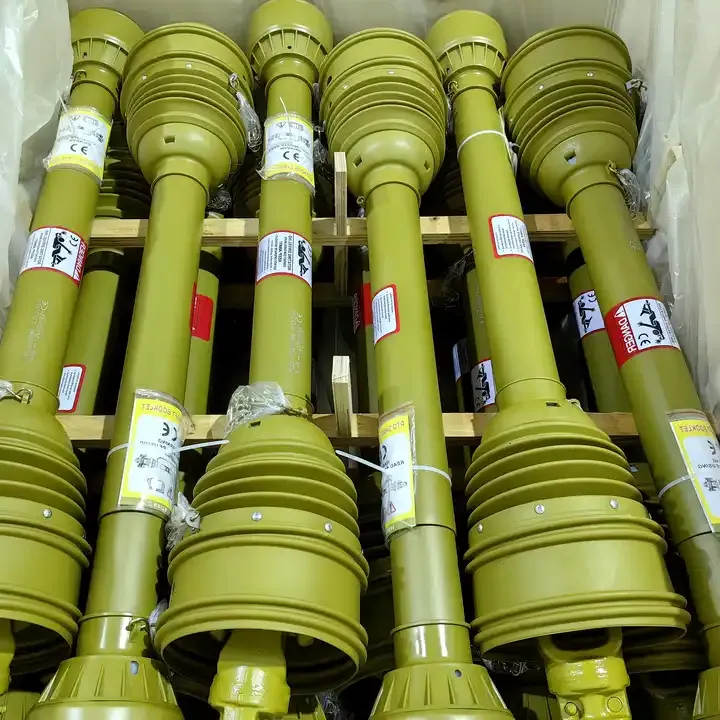
A PTO shaft with integrated torque limiter — the correct overload protection choice for rotary cutter applications
Why Rotary Cutters Are Hard on PTO Shafts
A rotary cutter blade rotating at 1,800–2,200 RPM carries significant kinetic energy. When that blade strikes an obstacle — a fence post, a hidden rock, a thick tree root — it decelerates violently in milliseconds. The kinetic energy stored in the blade has to go somewhere. In a properly equipped driveline, it is absorbed by the overload protection device (slip clutch or shear bolt). In an improperly specified or maintained driveline, it travels directly into the PTO shaft’s universal joints, the gearbox input shaft, the gearbox bevel gears, the PTO output bearing on the tractor, and ultimately the tractor’s own transmission.
The results of an underspecified or unprotected PTO shaft on a rotary cutter include: sheared universal joint cross arms, fractured yoke ears, stripped gearbox input splines, bent PTO output stubs, and in the worst cases, the complete separation of a spinning shaft. Understanding this damage chain is the foundation of correct shaft selection.
Torque shock loading
Peak torque during blade impact can be 5–10× normal operating torque. Joint series must be rated for this peak, not just average load.
Continuous high-speed operation
Cutters run at full PTO engagement for hours continuously. This accelerates U-joint bearing wear if greasing intervals are extended.
Debris exposure
Shredded vegetation and soil pack into U-joint shields and telescopic tubes, accelerating seal wear and blocking grease channels.
Step 1: Match the PTO Shaft to Your Tractor and Cutter
Confirm PTO Speed and Spline
Most rotary cutters are designed for 540 RPM PTO input. Confirm this in the cutter’s operator manual before ordering any shaft. The tractor-side yoke must have the correct spline count for your tractor’s PTO stub:
| Spline | Bore | RPM | Typical application |
|---|---|---|---|
| 6 spline | 1-3/8″ (35mm) | 540 | Most tractors under 100 HP |
| 20 spline | 1-3/8″ (35mm) | 540 | Italian standard (Fiat, Same, Lamborghini) |
| 21 spline | 1-3/4″ (45mm) | 1,000 | High-power cutters on large tractors |
Match the Joint Series to Your HP Rating
The joint series determines the shaft’s peak torque capacity. For rotary cutters, always select a series rated for at least 150% of your tractor’s PTO horsepower to account for shock loading. A 75 HP tractor delivers approximately 60–65 HP at the PTO — use a series rated for 90–100 HP minimum:
Series 4
Up to 35 HP
Small garden tractors
Series 6
Up to 65 HP
40–65 HP utility tractors
Series 8
Up to 130 HP
75–130 HP row crop tractors
Series 10
130+ HP
Large cutters, batwing mowers
Gearbox Input Spline: The Critical Interface
The implement-side yoke of the PTO shaft must mate with the rotary cutter gearbox input shaft. Confirm the spline count and bore diameter at the gearbox end — it is not always the same as the tractor end. When sourcing a replacement gearbox at the same time, ensure its input spline matches the PTO shaft yoke exactly. A range of agricultural gearboxes for rotary cutters, tillers, and spreaders is available from integrated drivetrain manufacturers who also produce PTO components — sourcing both from one supplier eliminates interface mismatch risk entirely. Browse our agricultural machine PTO drive shafts for series options matched to rotary cutter applications.
Shaft Length: The Two Measurements You Need
Measure the closed length (pin-to-pin with implement at full raised transport position) and the maximum extended length (implement at full lowered working position). The replacement shaft must not bottom out at the shortest position and must not extend more than two-thirds of its telescopic travel at maximum extension. If in doubt, order longer — an overlength shaft is adjustable; a short one is dangerous.
Step 2: Choose the Right Overload Protection
Every PTO shaft used on a rotary cutter must have overload protection. Operating a rotary cutter without a torque-limiting device is not only a threat to the driveline — it is a threat to the tractor’s transmission and the operator’s safety. Two protection types are available:
Friction Slip Clutch
How it works: A spring-loaded friction disc assembly allows the shaft to slip when torque exceeds a preset threshold. After the overload event, the shaft automatically re-engages as tension equalizes.
Best for: Routine mowing operations where occasional light strikes are expected. Automatic reset eliminates downtime from shear bolt replacement. Requires: Periodic adjustment of spring tension — a slip clutch that has never been adjusted can either slip under normal load or lock up and provide no protection.
Shear Bolt Clutch
How it works: A sacrificial bolt of specified grade and diameter shears cleanly at a calibrated torque level, disconnecting the shaft instantly. Requires manual replacement of the bolt before work can resume.
Best for: Rocky or stump-heavy ground where high-energy strikes are frequent. The hard stop is more positive than a slip clutch. Critical rule: Never replace a shear bolt with a grade-8 or hardened bolt. Only the specified bolt grade at the specified diameter provides the correct shear point — substitutes will destroy the gearbox instead of breaking.
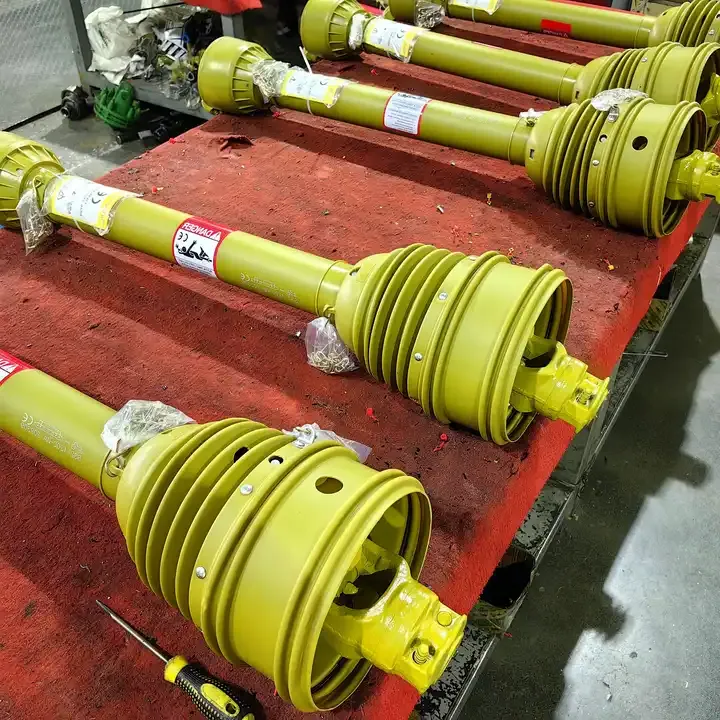
Slip clutch mechanism detail — the adjustment nut controls spring tension and therefore the torque at which the clutch releases
Step 3: Install the PTO Shaft Correctly
Correct installation eliminates the majority of premature PTO shaft failures. Follow these steps in order:
Grease before connecting. Apply lithium EP2 grease to the tractor PTO stub splines and the implement input splines before sliding the yokes into position. Dry spline engagement causes fretting wear from the first revolution.
Connect tractor end first, then implement end. This sequence lets you set the correct shaft length without fighting the implement’s weight. Slide the yoke fully onto the PTO stub until the locking pin audibly clicks into the groove.
Check U-joint phasing. Both universal joints must be phased identically — both input yoke ears in the same plane when viewed along the shaft axis. Incorrect phasing creates cyclic vibration at twice PTO speed, accelerating U-joint wear. Most replacement shafts are pre-phased correctly but verify after assembly.
Verify operating angle. With the cutter lowered to working height, measure the angle between the tractor PTO stub and the cutter input shaft. For standard U-joints, this must not exceed 15 degrees. If your three-point geometry creates a steeper angle, a wide-angle joint shaft is required.
Anchor the safety shield chains. The shield must be anchored at both ends so it does not rotate. Connect the restraining chains or clips to fixed points on the tractor and cutter. Never operate with an unanchored or missing shield.
Test at low RPM first. Engage the PTO at idle, listen for vibration or abnormal noise, and verify the slip clutch engages and releases smoothly. Only increase to full operating speed after confirming normal operation at idle.
Troubleshooting: The 5 Most Common Rotary Cutter PTO Problems
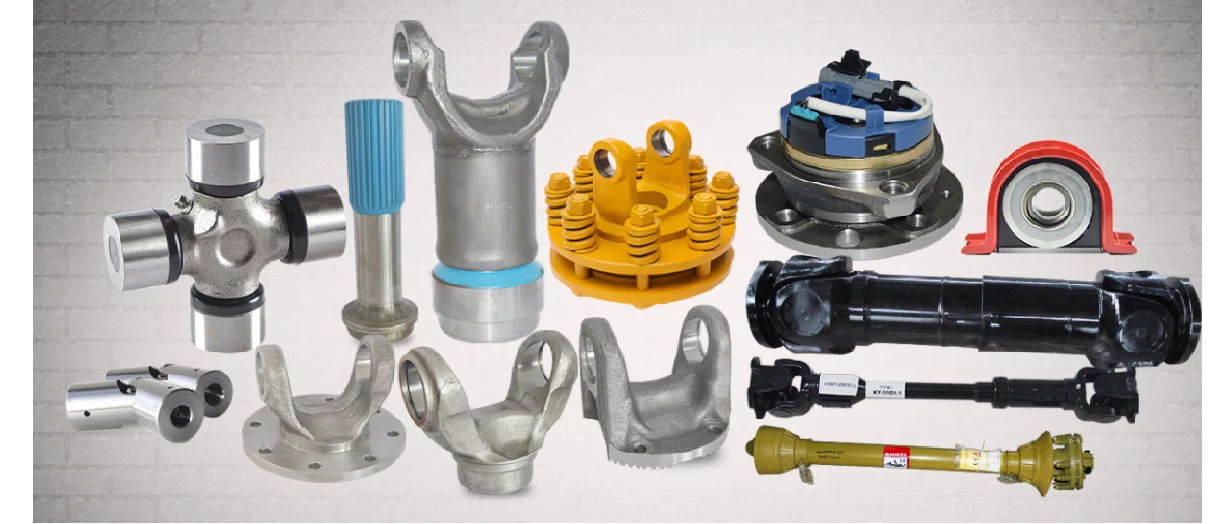
Understanding how each shaft component contributes to the driveline helps diagnose problems accurately
Problem 1: Excessive vibration during operation
Likely causes: Worn U-joint bearings with lateral play. Bent shaft tube from a previous overload. Incorrect U-joint phasing after reassembly. Operating angle exceeding joint rating.
Diagnosis: With the PTO disengaged and the shaft stationary, grip each side of each U-joint and rock. Any detectable movement indicates worn bearings. Sight along the shaft tubes for straightness. Re-verify joint phasing.
Problem 2: Slip clutch slipping during normal operation (not under impact)
Likely causes: Spring tension too low. Friction plates contaminated with grease or oil. Friction disc worn below minimum thickness.
Fix: Tighten the adjustment nut in small increments until the clutch holds at normal mowing load. If slipping persists after maximum adjustment, disassemble and inspect the friction discs — replacement disc kits are available and far less expensive than a new shaft assembly.
Problem 3: Shear bolts breaking too frequently
Likely causes: Wrong bolt grade (too weak). Operating in terrain with dense obstacles that produce frequent high-torque events. Gearbox developing internal stiffness from low oil level or contaminated oil.
Fix: Verify the bolt grade matches the operator manual specification exactly. Check gearbox oil level. Consider switching to a friction slip clutch for high-obstacle terrain where shear bolt replacement becomes impractical.
Problem 4: Telescopic section jamming or stiff to slide
Likely causes: Grease dried and contaminated with debris packing the profile channels. Profile tube surfaces galled from previous operation without adequate lubrication. Bent inner or outer tube.
Fix: Separate the tubes completely. Clean profile surfaces with solvent and a wire brush. Inspect for galling — light galling can be dressed with a fine file, but deep galling requires tube replacement. Apply a full film of fresh grease before reassembly.
Problem 5: Shaft disconnects from tractor PTO stub during operation
Likely causes: Worn locking pin spring that no longer holds the pin fully engaged. Tractor PTO stub groove worn round so pin cannot seat. Operator pulling the shaft off by hand without depressing the pin first.
Fix: Replace the locking pin and spring assembly — these are standard service parts for all push-pin yokes. If the stub groove is worn, the tractor PTO stub must be replaced before re-installing any shaft. Never attempt to wedge a pin or use tape to hold a worn connection.
Maintenance Schedule for Rotary Cutter PTO Shafts
Every 4–6 hours of mowing: Grease all U-joint fittings until fresh grease purges from all four bearing cup seals. Rotary cutter operation is more demanding than most agricultural applications — shorten the interval from the standard 8–10 hours.
Every 20 hours: Separate and re-grease the telescopic section. Inspect the safety shield for impact damage — rotary cutters throw debris and the shield takes a beating. Verify the shield restraint chains are still attached and intact.
End of season: Inspect U-joint play, tube profile surfaces, locking pins, and slip clutch friction plates. Replace any worn components before storage. Store the shaft horizontally, indoors or under cover, with a full fresh greasing to purge moisture from bearing cups.
After any major blade strike: Inspect the U-joints for play before resuming work. A blade-on-rock impact can create enough peak torque to initiate hairline cracks in a cross arm even when the overload protection device activated. Catching a damaged joint before the next use prevents a dangerous in-field failure.
For questions about PTO shaft selection for your rotary cutter, or to source a replacement shaft matched to your tractor’s HP and spline configuration, contact our team with your tractor model, cutter brand, and HP rating. We will identify the correct shaft series, length, and overload protection for your application. You can also browse our tractor PTO shaft range to check available series and overload protection options.