
Buying the wrong PTO shaft is a costly mistake that is entirely preventable. The correct replacement must match your existing shaft on six specific dimensions — and if any one of them is wrong, the shaft either will not connect, will not fit the equipment space, or will fail prematurely under load. This guide walks you through every measurement you need to take, the tools required, and exactly how to use those numbers to find the right replacement.
Whether your shaft has a legible part number or not, this method works. Even if the label is worn, rusted, or missing entirely, six physical measurements will tell you everything a supplier needs to identify or manufacture your replacement.
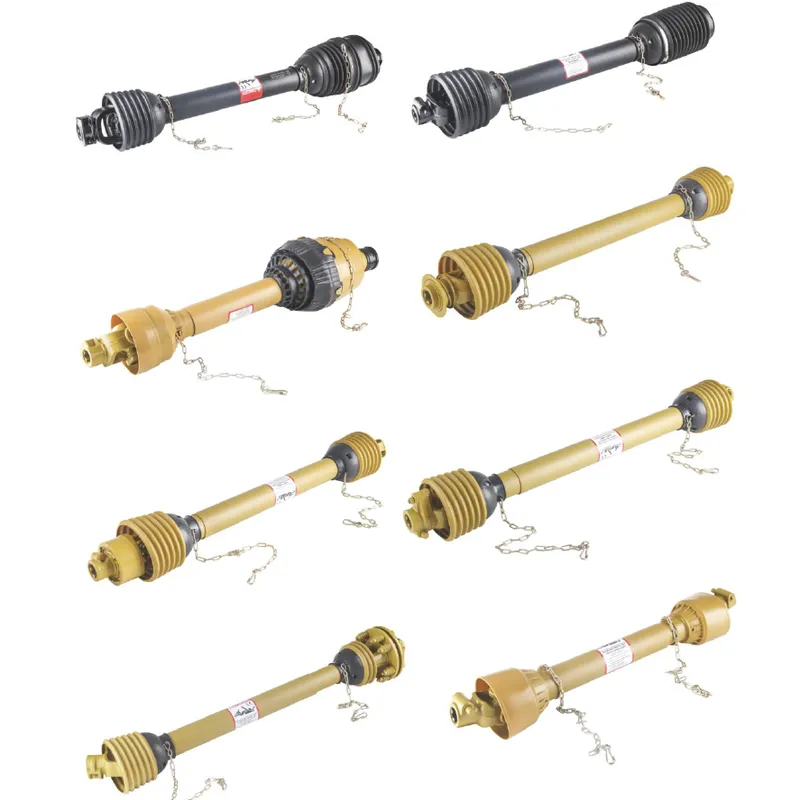
Understanding PTO shaft structure is the first step to accurate measurement and replacement
Why Accurate Measurement Matters Before You Order
PTO shafts are not universally interchangeable. Even shafts that look visually similar can have different bore spline counts, tube profiles, or closed lengths that make them incompatible with your specific tractor and implement combination. The consequences of ordering the wrong shaft include:
Wrong closed length
The shaft is too long when retracted — it bottoms out and bends, or is too short and separates under extension.
Wrong spline count
The yoke will not slide onto the PTO stub or the implement input shaft. 6-spline and 21-spline stubs are the same RPM but physically incompatible.
Wrong tube profile
Triangular (lemon) and star profiles cannot be swapped — the inner and outer tubes must match in profile type to transmit torque.
Tools You Need
You do not need specialized equipment to measure a PTO shaft accurately. The following tools are sufficient for all six measurements:
Tape measure or steel rule — For shaft lengths, closed length, and extension length.
Vernier caliper or digital caliper — For measuring tube outer diameter, rod diameter, and spline dimensions precisely.
Smartphone camera — To photograph both yoke ends, the tube profile cross-section, and any visible markings.
Notepad — Record all measurements immediately. Do not rely on memory when placing an order.
The 6 Measurements You Must Take
Closed Length (Pin-to-Pin)
What it is: The total length of the assembled shaft from the center of the tractor-end connecting pin to the center of the implement-end connecting pin, with the telescopic section fully retracted.
How to measure: Install the shaft on the equipment with the implement raised to its highest transport position. Measure pin center to pin center with a tape measure. If the shaft is already removed, collapse it to its shortest position and measure pin-to-pin.
⚠ Critical: This is the most commonly measured dimension and also the most commonly measured incorrectly. Always measure with the implement in its working position, not the transport position, unless your implement travels a very different distance in working position.
Maximum Extended Length
What it is: The pin-to-pin length with the telescopic section fully extended. This is the length the shaft reaches when the implement is in its lowest working position or when the tractor makes a tight turn.
How to measure: Lower the implement to its lowest working position. Measure pin center to pin center. If measuring the shaft off the equipment, extend it to maximum travel and measure.
Rule of thumb: The shaft should never be more than two-thirds extended during normal operation. If maximum extension approaches full extension during normal work, the shaft is too short.
Tube Outer Diameter and Profile Type
What it is: The outside dimension of the shaft tubes and the shape of their cross-section. PTO drive shafts use profiled tubes — not round — to transmit torque through the telescopic section.
How to measure: Use a caliper to measure the outer diameter of the profile at its widest point. Identify the tube profile by looking at the cross-section:
Triangular / Lemon
Three-sided rounded triangle. Most common for light-to-medium duty applications.
Star Profile
Six-pointed star shape. Higher torque capacity. Common for medium to heavy duty.
Splined Tube
External splines on the tube. Highest torque capacity. Heavy-duty applications.
Spline Count and Bore Diameter (Both Ends)
What it is: The number of spline teeth in the bore of each yoke, and the diameter of the bore. These must match the PTO output stub on the tractor and the input shaft of the implement exactly.
How to count: Count the number of internal teeth visible around the bore. The most common agricultural spline configurations are:
| Spline Count | Bore Diameter | PTO Speed | Common Use |
|---|---|---|---|
| 6 splines | 1-3/8″ (35mm) | 540 RPM | Standard 540 RPM tractor PTO |
| 21 splines | 1-3/4″ (45mm) | 1,000 RPM | High-speed/high-power implements |
| 20 splines | 1-3/8″ (35mm) | 540 RPM | Italian standard 540 RPM |
| 6 splines | 1-3/4″ (45mm) | 1,000 RPM | Older 1000 RPM configuration |
Yoke Type and Pin Diameter
What it is: The connection method at each end of the shaft — how the yoke attaches to the PTO stub and implement input — and the diameter of the pins used for that connection.
How to identify: The most common yoke types in agricultural PTO shafts are push-pin (a spring-loaded locking pin), interfering bolt (a clamping bolt through the yoke collar), and cross-pin (a removable cross bolt). Measure the pin hole diameter with calipers. Photograph both ends clearly — this is the detail most suppliers need to confirm fit.
Cross Joint Series Size
What it is: The series designation of the universal joint cross kits fitted at each end. The series determines the cross dimensions, torque capacity, and bearing cup diameter.
How to identify: Measure the outside diameter of the bearing cups (the cylindrical cups that press into the yoke ears). Common series sizes range from Series 1 (bearing cup OD ~27mm) to Series 8 (bearing cup OD ~57mm). If you cannot measure directly, note the shaft’s HP application — light 25HP implements typically use Series 1-2, medium 50HP implements use Series 4-6, and heavy 100HP+ implements use Series 6-8. See our tractor PTO shaft range for cross-series availability.
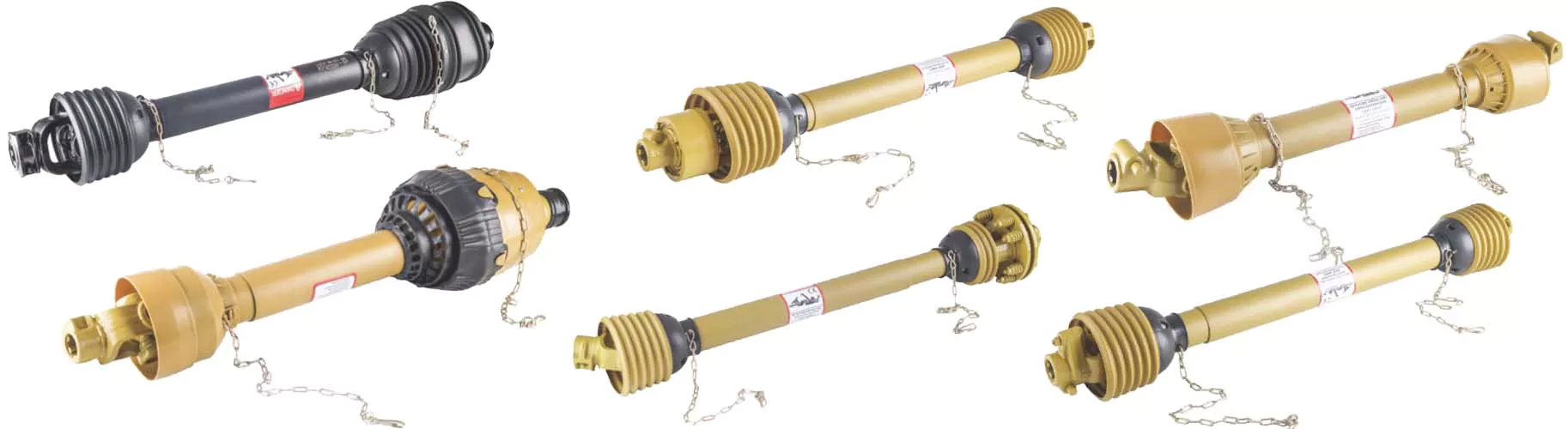
Different PTO shaft types have different spline counts, tube profiles, and yoke styles — all must be matched precisely
How to Use Your Measurements to Find the Right Replacement
Once you have all six measurements, you have two paths to finding the correct replacement:
Path A: Supplier Cross-Reference
Send your measurements — or the original part number if readable — to a PTO shaft supplier. Many manufacturers with a broad catalog can match your specifications to an existing standard part. Manufacturers with integrated drivetrain product ranges — including PTO shafts, gearboxes, and hydraulic cylinders — like SSJ Group can cross-reference your measurements and recommend the correct replacement within 24 hours. Alternatively, browse our range of agricultural machinery PTO drive shafts to check whether a standard catalog item already matches your specification.
Path B: Custom Manufacturing
If your shaft has non-standard dimensions — common on older European or specialty equipment — custom manufacturing is the alternative. Provide your complete measurement set and photographs. A qualified manufacturer can produce a custom-length shaft with specified yoke types and tube profiles. Lead time is typically 7–21 days depending on complexity and volume.
Quick-Reference: What Each Measurement Tells the Supplier
| Measurement | What it determines | Critical? |
|---|---|---|
| Closed length (pin-to-pin) | Retracted shaft length — determines fit in compressed position | ★★★ |
| Maximum extended length | Amount of telescopic travel — shaft must reach full working extension | ★★★ |
| Tube profile and diameter | Torque capacity and series compatibility of the telescopic section | ★★★ |
| Spline count and bore diameter | Connection compatibility with tractor PTO stub and implement input | ★★★ |
| Yoke type and pin diameter | Physical connection method — push-pin, bolt, or cross-pin style | ★★ |
| Cross joint series | Universal joint torque rating and bearing cup dimensions | ★★ |
4 Common Measurement Mistakes to Avoid
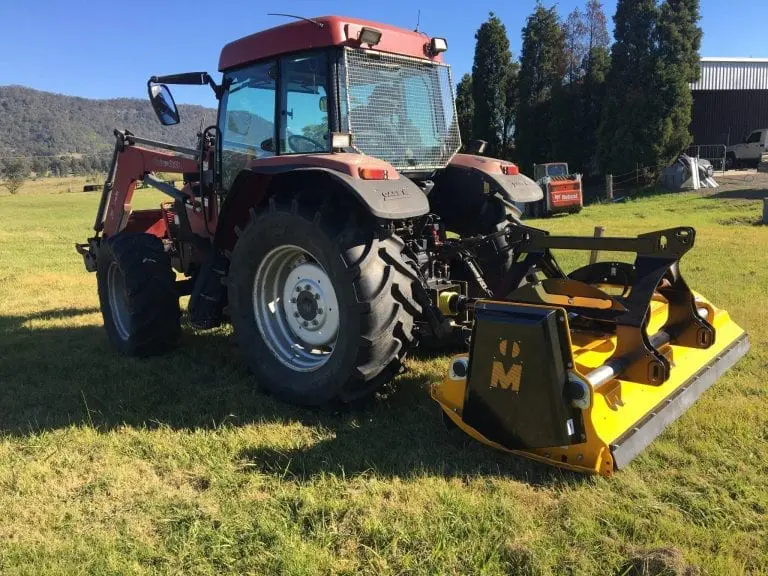
Identify each component clearly before measuring — yoke type, tube profile, and joint series all affect replacement selection
Measuring overall length instead of pin-to-pin. Overall length includes the yoke bodies extending beyond the pin holes. Suppliers need pin center to pin center — typically 20–60mm shorter than overall shaft length depending on yoke design.
Counting external splines instead of internal bore splines. The yoke bore has internal splines that engage the PTO stub. These are more difficult to count than external splines but are the critical dimension. Use a flashlight and photograph the bore for later counting.
Measuring the collapsed shaft not installed on the equipment. The implement geometry affects the working closed length. A shaft measured off the equipment in free collapse may be different from the effective pin-to-pin when installed and the implement is in the transport position.
Assuming both ends have the same spline configuration. On some PTO shafts — especially those connecting non-standard implements — the tractor-side yoke and the implement-side yoke have different spline counts or bore diameters. Measure and photograph both ends separately.
For questions about PTO shaft sizing, product compatibility, or to request a quote for replacement PTO shafts, contact our team with your measurements and photographs for expert assistance.