
Spline compatibility is the single most consequential specification in PTO shaft selection. Every other measurement — length, tube diameter, joint series — determines performance. Spline mismatch determines whether the shaft connects at all. A 6-spline yoke on a 21-spline stub will not engage. A 20-spline Italian-standard yoke on a 6-spline American-standard stub will fit but transmit power incorrectly, slipping under load and destroying both components in minutes.
The confusion is understandable. Tractors from different countries follow different spline standards. Some shafts have different spline counts at each end. And the shaft tube profile — the cross-sectional shape that allows torque transmission through the telescopic section — uses a completely separate vocabulary from the yoke splines. This guide untangles all of it: the major yoke spline standards and where each is used, the tube profile types and how to identify them, and how spline interface compatibility extends across the full drivetrain.
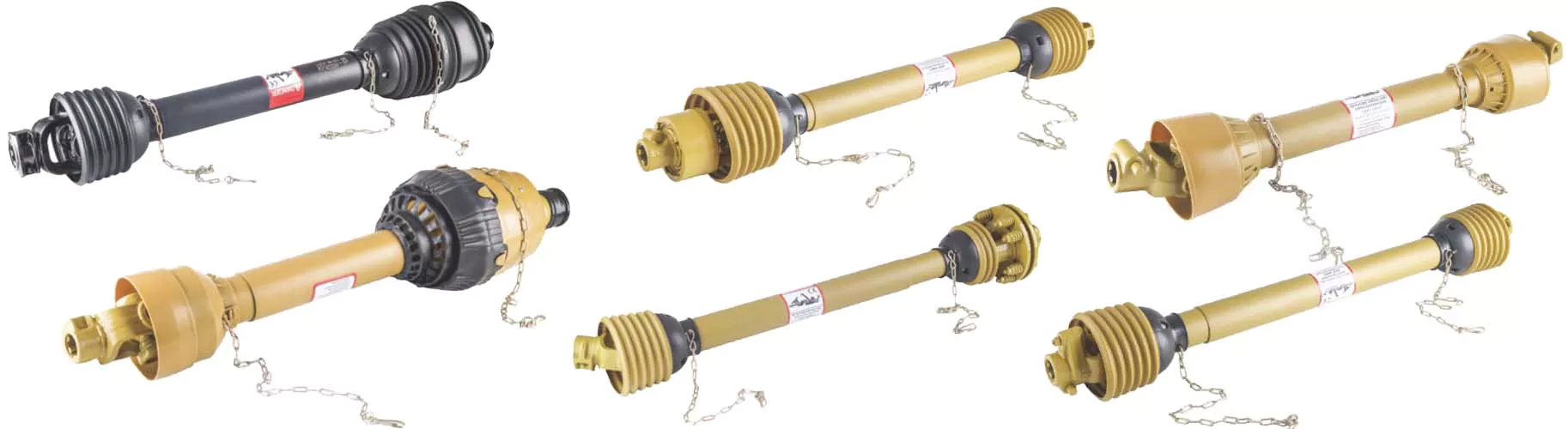
PTO shaft types vary in spline count, bore diameter, tube profile, and joint series — all must be matched to the specific tractor and implement
Part 1: Yoke Spline Standards — The Tractor Connection
The yoke bore spline is the interface between the PTO shaft and the tractor’s PTO output stub (or the implement’s gearbox input shaft). Spline count, bore diameter, and tooth profile must all match precisely. There is no tolerance — either the splines engage cleanly or they do not.
The Four Major Agricultural PTO Spline Standards
6-Spline, 1-3/8″ (35mm) Bore — The Universal Standard
The most widely used PTO spline standard in the world. Found on the vast majority of tractors under 100 HP manufactured in North America, Europe, and Asia from the 1950s to the present. Six evenly spaced involute teeth on a 1-3/8 inch (35.0mm) bore diameter. Rated for 540 RPM operation.
35mm bore
John Deere · Massey · New Holland · Kubota · Deutz
21-Spline, 1-3/4″ (45mm) Bore — High-Power Standard
The standard for 1,000 RPM PTO operation on modern high-horsepower tractors. Twenty-one closely spaced teeth on a 1-3/4 inch (45.0mm) bore diameter. The larger bore and greater number of teeth distribute torque over a larger contact area, enabling reliable power transmission at nearly double the rotational speed of 540 RPM systems. Found on large row crop tractors and high-power implements.
45mm bore
Large tractors 100 HP+
20-Spline, 1-3/8″ (35mm) Bore — Italian Standard
A 540 RPM standard used primarily on Italian-manufactured tractors (Fiat, Same, Lamborghini, Landini) and the implements designed for them. Twenty teeth on the same 1-3/8 inch bore as the 6-spline standard — making them physically similar in diameter but mechanically incompatible. A 20-spline yoke will partially engage a 6-spline stub but will not transmit torque reliably and will destroy the stub teeth quickly. Always verify the count, not just the diameter.
35mm bore
Fiat · Same · Lamborghini · Landini
6-Spline, 1-3/4″ (45mm) Bore — Older 1,000 RPM
An older 1,000 RPM standard found on some European tractors from the 1970s–1990s before the 21-spline configuration became universal. Six teeth on the larger 1-3/4 inch bore. This spline appears on some German and British tractors of that era. Replacement shafts with this configuration are available but less commonly stocked — confirm the specification before ordering.
45mm bore
Older European tractors
Quick Identification: How to Count Splines Without a Reference Chart
To count internal splines in a yoke bore, shine a flashlight into the bore at an angle. The spline teeth cast distinct shadows. Count the valleys (not the peaks) — there are always the same number of valleys as peaks for an even spline count. Photograph the bore from directly above for a clean reference image. If a digital caliper is available, measure the bore diameter: approximately 35mm confirms a 1-3/8 inch bore; approximately 45mm confirms a 1-3/4 inch bore. Together, bore diameter plus tooth count uniquely identifies the spline standard.
| Spline count | Bore diameter | PTO speed | Primary market | Compatible with |
|---|---|---|---|---|
| 6 | 1-3/8″ (35mm) | 540 RPM | Global standard | 6-spline stubs only |
| 21 | 1-3/4″ (45mm) | 1,000 RPM | Modern standard | 21-spline stubs only |
| 20 | 1-3/8″ (35mm) | 540 RPM | Italy | 20-spline stubs only |
| 6 | 1-3/4″ (45mm) | 1,000 RPM | Older Europe | 6-spline 45mm stubs only |
Part 2: Tube Profile Types — The Telescopic Section
The tube profile is the cross-sectional shape of the inner and outer telescopic tubes. Unlike the yoke splines which transmit torque between the shaft and the tractor/implement, the tube profile transmits torque through the shaft itself as it extends and compresses. The inner profile tube must slide freely inside the outer profile tube while maintaining a torque-transmitting fit — round tubes would spin freely inside each other under load, which is why profiled cross-sections are used.
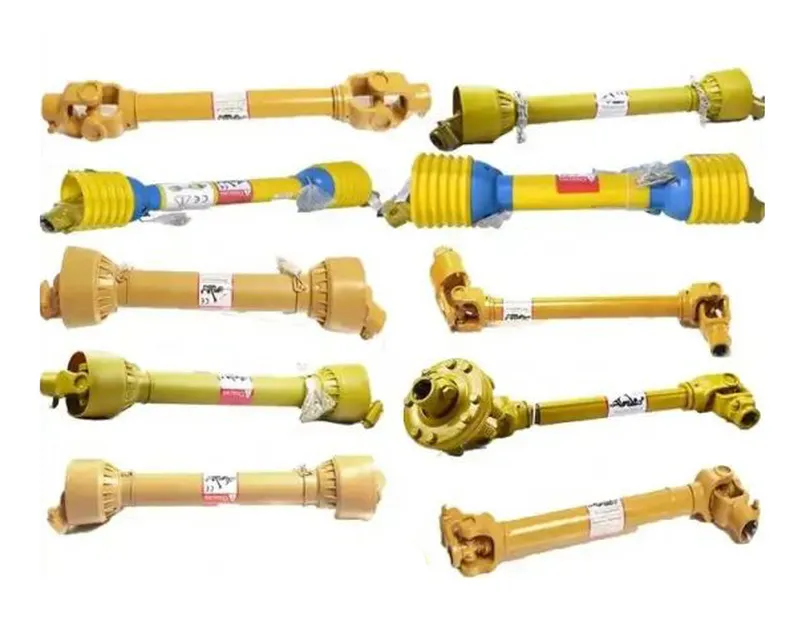
Tube profile cross-sections — the shape of the inner and outer tubes determines torque capacity and must match between inner and outer
The Three Main Tube Profile Types
Triangular (Lemon)
A three-sided rounded triangle cross-section — wider in the middle and tapered at each corner. The most common profile in agricultural PTO applications. Widely available in all standard series sizes. Provides good torque capacity for light to medium duty work. The smooth rounded corners produce less vibration and run more quietly than angular profiles.
Best for: Mowers, tillers, spreaders, light balers
Star (6-Point)
A six-pointed star cross-section with alternating ridges and valleys around the circumference. Greater contact surface area than the triangular profile, providing higher torque capacity at the same tube diameter. More commonly found in Series 6 and above shafts designed for higher-horsepower applications. Somewhat louder in operation than the lemon profile due to its more angular geometry.
Best for: Heavy mowers, high-torque tillers, round balers
Splined Tube
External splines machined around the outside of the inner tube, engaging internal splines inside the outer tube — essentially the same principle as a yoke-to-stub connection, but scaled to the tube. The highest torque capacity of any profile type. Used in the heaviest-duty agricultural shafts (Series 8 and above) and industrial driveshafts. Requires more precise manufacturing and is significantly more expensive than profiled tubes.
Best for: Square balers, silage equipment, 100 HP+ applications
⚠ Critical compatibility rule: Inner and outer tubes must be the same profile type and the same series size. A lemon inner tube will not transmit torque inside a star outer tube. A Series 4 inner tube will slide loosely inside a Series 6 outer tube. When sourcing replacement tubes, confirm both the profile type and the series designation.
Part 3: Shafts with Different Splines at Each End
Not all PTO shafts are symmetrical. Some applications require different spline configurations at the tractor end and the implement end. Common scenarios include:
6-spline tractor / 20-spline implement
Common when a North American tractor is used with an Italian-origin implement, or when an older implement with an Italian-standard gearbox input is paired with a standard North American tractor. The shaft must have a 6-spline 1-3/8″ yoke at the tractor end and a 20-spline 1-3/8″ yoke at the implement end.
21-spline tractor / 6-spline implement
Occurs when a modern high-HP tractor with a 1,000 RPM PTO is used with an older implement designed for 540 RPM. Requires either a speed-reduction gearbox or a shaft configuration that accommodates both ends — not a simple mixed-spline shaft, since the speeds are incompatible.
Square-end or keyed implement input
Some older or specialty implements use a square-bore or keyed bore at the gearbox input rather than a spline. These require a yoke machined to match the specific implement’s input bore. Custom yoke configurations are available for most series sizes.
Part 4: Spline Compatibility Across the Full Drivetrain
Spline interface compatibility extends beyond the PTO shaft itself. The spline must match through the complete power transmission chain, from the tractor PTO output stub all the way through the shaft to the implement gearbox input shaft. But that gearbox then drives further downstream components — and if those downstream components are hydraulically positioned, their cylinders affect the mechanical interface too.
A hydraulic lift cylinder that allows an implement to drop during work changes the height relationship between the tractor PTO stub and the implement input shaft, changing the operating angle at both U-joints. For steep-angle applications, a wide-angle PTO shaft rated for higher operating angles is the mechanical solution. Suppliers who manufacture hydraulic cylinders alongside PTO and gearbox components have the cross-product engineering expertise to ensure all interfaces are compatible — including the mechanical geometry that spline selection depends on.
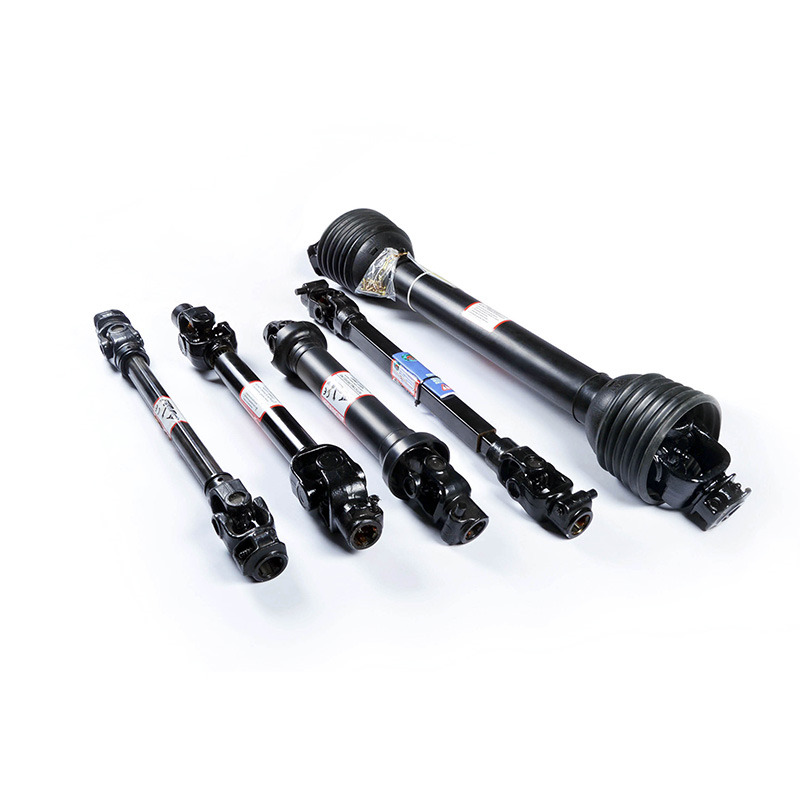
The complete shaft assembly — yoke splines, tube profile, joint series, and shield must all be specified together
How to Specify a PTO Shaft by Spline and Profile
When ordering a replacement or custom PTO shaft, provide the following spline and profile information alongside the dimensional measurements:
Tractor-end specification: Spline count + bore diameter + yoke locking style (push-pin / interfering bolt / spring collar). Example: 6-spline, 1-3/8″, push-pin yoke.
Implement-end specification: Spline count + bore diameter + yoke locking style. May be different from the tractor end. Example: 20-spline, 1-3/8″, interfering bolt yoke.
Tube profile: Triangular (lemon) / star / splined. Example: Triangular (lemon) profile.
Series: Joint series designation. Example: Series 6.
Shaft dimensions: Closed length (pin-to-pin), maximum extended length. Example: 850mm closed, 1,150mm extended.
If any of these specifications are unknown, a photograph of both yoke ends and the tube cross-section — taken by removing the safety shield and photographing the tube end-on — provides enough information for an experienced supplier to identify the correct configuration. Browse our heavy-duty PTO shaft range covering Series 4 through Series 10 in all major spline and profile configurations, or contact our team with your measurements and photographs for a matched recommendation.